How Creative Play Builds Problem-Solving Skills
Creative play gives children room to decide what they want to make and how to approach it. A block bridge, a pretend shop, or a drawing can present a small problem with more than one possible answer. For children ages one to five, those everyday decisions are more useful than a demand to produce an impressive finished object. Parents can help by choosing manageable materials, staying curious, and resisting the urge to solve every difficulty immediately. This guide offers practical ways to support experimentation while recognising that frustration sometimes calls for help or a break. The focus is participation and discovery, not performance.
How does creative play give children problem-solving practice?
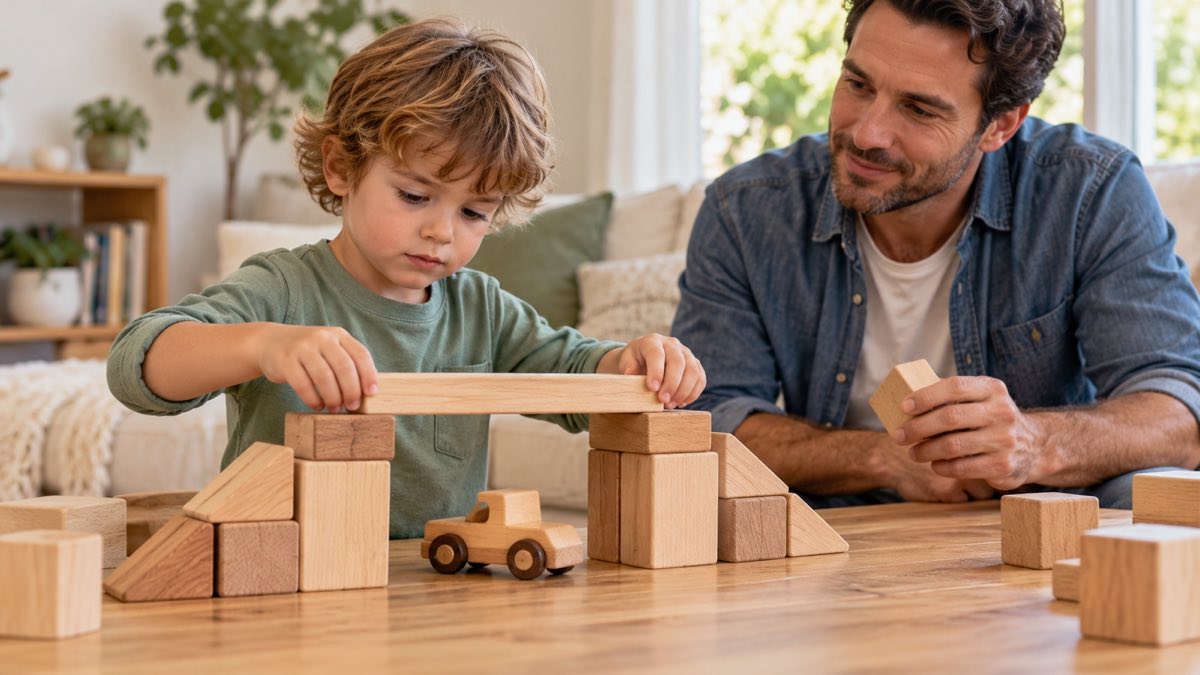
Creative play gives children problem-solving practice by letting them try an idea, observe what happens, and decide what to change. If a block bridge collapses, a child might move the supports closer together or choose a shorter piece for the top. The result provides immediate feedback without a worksheet or a score. An adult can make that process easier to notice by describing it: “You changed the space between the blocks.” Avoid turning every attempt into a lesson about the correct engineering solution. Some children will prefer to transform the bridge into a house, and that can be a valid creative choice. These experiences offer opportunities for flexible thinking, but they do not guarantee a particular academic outcome. The value is in having a manageable problem the child cares about solving.
Which materials encourage more than one possible solution?
Materials that can be arranged, combined, or used in different pretend roles invite a range of possible solutions. Large blocks, sturdy cardboard boxes without staples, and age-appropriate drawing materials are useful examples. Begin with a small selection so choosing does not become overwhelming. You might place a few blocks beside a toy vehicle and see whether your child makes a road, garage, or something unexpected. Open-ended play does not require buying a special collection or rejecting toys with a defined purpose. A familiar puzzle can also become an opportunity to try different approaches. Check size guidance and avoid small loose parts for children who may swallow them. Choose materials you can supervise comfortably, and remove damaged pieces. What matters is room for the child's decisions within a safe, manageable setup.
What can parents say without taking over the activity?
Parents can support creative thinking with observations and occasional open questions that leave the solution to the child. Try “That piece keeps sliding” before asking “What might help it stay?” Then pause long enough for an experiment, a gesture, or an answer. If your child does not respond, you can stay nearby without adding more questions. Offer a small practical choice when needed: “Would you like me to hold the box, or will you try it on the floor?” Avoid repeatedly asking what an artwork represents or correcting a pretend object's purpose. A circle can be a wheel, a pond, or simply a circle. Follow the meaning your child gives it. Your attention is often more useful than a stream of suggestions, especially when they are already absorbed in an idea.
How should adults respond when an idea does not work?
When an idea does not work, acknowledge the difficulty and help your child choose between trying again, changing direction, or taking a break. You might say, “The roof fell and you are disappointed. Shall I hold one side while you try?” That response recognises the feeling without presenting failure as something the child must immediately enjoy. If they want another attempt, change just one feature so the result is easier to understand. If they stop, leave the materials available for later when practical. Persistence is not the same as continuing through distress. You can also model a modest mistake in your own play and describe your next step. Keep it natural rather than staging a performance. The useful message is that difficulties can be approached in different ways and support is available.
How can a busy family make creative play easier to offer?
A busy family can make creative play easier by keeping a small, accessible set of suitable materials and allowing unfinished projects to continue later. Choose a location where setup and cleanup are manageable, such as a tray for drawing or a clear floor space for blocks. Offer the invitation at a time when you can remain available without directing every moment. Reuse familiar materials rather than searching for a new themed activity each day. You could photograph a construction before taking it apart, if your child wants a reminder for next time. Ask what they would like to keep or change instead of judging the result. Some sessions will be brief and others more involved. A sustainable arrangement that fits your household is more valuable than an elaborate setup that is rarely used.
Ready to Support Your Child's Development?
Explore our expert-designed kits tailored to your child's age and developmental stage.
Browse Kits